Hanged Dreams: Bilawal Kori and the Case of Child Abuse in Pakistan

What could be more gruesome, horrendous and disheartening than the death of a little child, and that too by hanging in a small Tyre shop, where he was reportedly forced to work. A place where he treaded tires to feed his stomach proved to be gallows for him. Bilawal Kori was that unfortunate child, who couldn’t make it home from work on the eve of August 13th. His body was found hanging by the very same tires that he used to fix for a meager daily wage. It hasn’t been ascertained yet whether this is a case of suicide or homicide as no criminal charges have been filed, no arrest made and the autopsy report isn’t back from the medical department. This isn’t the first case of such savagery. Earlier this year, Zainab, a 6 years old Pakistani girl from the city of Kasur, was raped and murdered in cold blood by a sadistic criminal. There is a big possibility that Bilawal’s death, like Zainab, could be a result of resisting sexual assault.

In Pakistan, sexual predators are largely on the loose as there is no centralized registry to keep track of habitual offenders of this sort. Due to the conservative patriarchal structure of the society and the stigma related to rape, most crimes related to sexual assault are never reported. As a result, physical and sexual abuse of children goes unnoticed until a large scale calamity happens. Crime is one thing, brutality is totally another. One is prevalent in all nations and societies, however, to kill with impunity while the rest of the society is totally indifferent about it is a work of pure evil, on the side of the criminal himself and on the side of the society at large. The menace of child labor coupled with bonded labor creates a perfect atmosphere for the tragic incidents of abuse.

According to a report by USA’s Labor Department, “In 2016, Punjab Province passed the Punjab Restriction on Employment of Children Act, which establishes age 15 as the minimum age for employment and age 18 as the minimum age for employment in hazardous work. The Province also passed the Punjab Prohibition of Child Labor at Brick Kilns Act, which prohibits the employment of children under age 14 at brick kilns.) During the year, Sindh Province passed laws prohibiting children under age 15 from working in factories and commercial establishments. Sindh Province also passed the Sindh Bonded Labor System (Abolition) Act. The Federal Government gave the final approval for the Criminal Law (Second Amendment) Act, which prohibits the use of children in pornography.”

Only the province of Punjab has made some inroads. Other provinces, including the province where this incident took place, are still following the national statues. Child labor and bonded labor expose vulnerable children to the dangerous conditions. Most parents fail to provide added care and protection to their children.
The lack of proper legislation and implementation of laws, ensuring that all children are admitted to the school, is also an essential cause of the worsening situation of children in our country. A large number of children are out of school, the psycho-emotional need of children are not taken care of adequately, putting them at greater risk. In order to curb such menaces, the government must work to design a comprehensive socio-cultural policy and ensure that the policy is implemented.

It is impossible to eradicate crimes of this nature entirely, but it is very much feasible to formulate a structure of deterrence and a strong national will to address and resolve this issue. Children are every nation’s future and leaving our children at the risk of such dangerous situations would only lead our country towards darkness.

The most potent way to end this menace would be to ensure universal education, diminish the dropout rate, provide financial support to children in need and impart formal sex education. We must make our culture more conducive and encourage children to speak up their mind, question things and resist oppressive authority.
Making parents more responsible for children is also a need of the time. Parents must be educated that their duty to support their children, not vice versa. Society as a whole must also be made more safe and secure. The institutional enforcement of organizations like child protection unit and special victim units in law enforcement can boost the vigilance and thwart crimes at such scale.


About the Author

26167344_10212828248435883_3624844790525450071_n.jpg
Mr. Faisal Raza is a social-cultural critic and anonymous dreamer based in Houston, Texas.

What are Human Rights?

Human rights are rights inherent to all human beings, whatever our nationality, place of residence, sex, national or ethnic origin, color, religion, language, or any other status. We are all equally entitled to our human rights without discrimination. These rights are all interrelated, interdependent and indivisible.

Universal human rights are often expressed and guaranteed by law, in the forms of treaties, customary international law , general principles and other sources of international law. International human rights law lays down obligations of Governments to act in certain ways or to refrain from certain acts, in order to promote and protect human rights and fundamental freedoms of individuals or groups.

maxresdefault.jpg

Universal and inalienable

The principle of universality of human rights is the cornerstone of international human rights law. This principle, as first emphasized in the Universal Declaration on Human Rights in 1948, has been reiterated in numerous international human rights conventions, declarations, and resolutions. The 1993 Vienna World Conference on Human Rights, for example, noted that it is the duty of States to promote and protect all human rights and fundamental freedoms, regardless of their political, economic and cultural systems.

All States have ratified at least one, and 80% of States have ratified four or more, of the core human rights treaties, reflecting consent of States which creates legal obligations for them and giving concrete expression to universality. Some fundamental human rights norms enjoy universal protection by customary international law across all boundaries and civilizations.

Human rights are inalienable. They should not be taken away, except in specific situations and according to due process. For example, the right to liberty may be restricted if a person is found guilty of a crime by a court of law.

Interdependent and indivisible

All human rights are indivisible, whether they are civil and political rights, such as the right to life, equality before the law and freedom of expression; economic, social and cultural rights, such as the rights to work, social security and education , or collective rights, such as the rights to development and self-determination, are indivisible, interrelated and interdependent. The improvement of one right facilitates advancement of the others. Likewise, the deprivation of one right adversely affects the others.

cover2.jpg

Equal and non-discriminatory

Non-discrimination is a cross-cutting principle in international human rights law. The principle is present in all the major human rights treaties and provides the central theme of some of international human rights conventions such as the International Convention on the Elimination of All Forms of Racial Discrimination and the Convention on the Elimination of All Forms of Discrimination against Women.

The principle applies to everyone in relation to all human rights and freedoms and it prohibits discrimination on the basis of a list of non-exhaustive categories such as sex, race, color and so on. The principle of non-discrimination is complemented by the principle of equality, as stated in Article 1 of the Universal Declaration of Human Rights: “All human beings are born free and equal in dignity and rights.”

Both Rights and Obligations

Human rights entail both rights and obligations. States assume obligations and duties under international law to respect, to protect and to fulfill human rights. The obligation to respect means that States must refrain from interfering with or curtailing the enjoyment of human rights. The obligation to protect requires States to protect individuals and groups against human rights abuses. The obligation to fulfill means that States must take positive action to facilitate the enjoyment of basic human rights. At the individual level, while we are entitled our human rights, we should also respect the human rights of others.

Source: www.ohchr.org

Universal Declaration of Human Rights

Introduction

The Universal Declaration of Human Rights (UDHR) is a milestone document in the history of human rights. Drafted by representatives with different legal and cultural backgrounds from all regions of the world, the Declaration was proclaimed by the United Nations General Assembly in Paris on 10 December 1948 (General Assembly resolution 217 A) as a common standard of achievements for all peoples and all nations. It sets out, for the first time, fundamental human rights to be universally protected and it has been translated into over 500 languages.

Preamble

Whereas recognition of the inherent dignity and of the equal and inalienable rights of all members of the human family is the foundation of freedom, justice and peace in the world, Whereas disregard and contempt for human rights have resulted in barbarous acts which have outraged the conscience of mankind, and the advent of a world in which human beings shall enjoy freedom of speech and belief and freedom from fear and want has been proclaimed as the highest aspiration of the common people, Whereas it is essential, if man is not to be compelled to have recourse, as a last resort, to rebellion against tyranny and oppression, that human rights should be protected by the rule of law, Whereas it is essential to promote the development of friendly relations between nations, Whereas the peoples of the United Nations have in the Charter reaffirmed their faith in fundamental human rights, in the dignity and worth of the human person and in the equal rights of men and women and have determined to promote social progress and better standards of life in larger freedom, Whereas Member States have pledged themselves to achieve, in co-operation with the United Nations, the promotion of universal respect for and observance of human rights and fundamental freedoms, Whereas a common understanding of these rights and freedoms is of the greatest importance for the full realization of this pledge,

Now, Therefore THE GENERAL ASSEMBLY proclaims THIS UNIVERSAL DECLARATION OF HUMAN RIGHTS as a common standard of achievement for all peoples and all nations, to the end that every individual and every organ of society, keeping this Declaration constantly in mind, shall strive by teaching and education to promote respect for these rights and freedoms and by progressive measures, national and international, to secure their universal and effective recognition and observance, both among the peoples of Member States themselves and among the peoples of territories under their jurisdiction.

Article 1.

All human beings are born free and equal in dignity and rights. They are endowed with reason and conscience and should act towards one another in a spirit of brotherhood.

Article 2.

Everyone is entitled to all the rights and freedoms set forth in this Declaration, without distinction of any kind, such as race, colour, sex, language, religion, political or other opinion, national or social origin, property, birth or other status. Furthermore, no distinction shall be made on the basis of the political, jurisdictional or international status of the country or territory to which a person belongs, whether it be independent, trust, non-self-governing or under any other limitation of sovereignty.

Article 3.

Everyone has the right to life, liberty and security of person.

Article 4.

No one shall be held in slavery or servitude; slavery and the slave trade shall be prohibited in all their forms.

Article 5.

No one shall be subjected to torture or to cruel, inhuman or degrading treatment or punishment.

Article 6.

Everyone has the right to recognition everywhere as a person before the law.

Article 7.

All are equal before the law and are entitled without any discrimination to equal protection of the law. All are entitled to equal protection against any discrimination in violation of this Declaration and against any incitement to such discrimination.

Article 8.

Everyone has the right to an effective remedy by the competent national tribunals for acts violating the fundamental rights granted him by the constitution or by law.

Article 9.

No one shall be subjected to arbitrary arrest, detention or exile.

Article 10.

Everyone is entitled in full equality to a fair and public hearing by an independent and impartial tribunal, in the determination of his rights and obligations and of any criminal charge against him.

Article 11.

(1) Everyone charged with a penal offence has the right to be presumed innocent until proved guilty according to law in a public trial at which he has had all the guarantees necessary for his defence.
(2) No one shall be held guilty of any penal offence on account of any act or omission which did not constitute a penal offence, under national or international law, at the time when it was committed. Nor shall a heavier penalty be imposed than the one that was applicable at the time the penal offence was committed.

Article 12.

No one shall be subjected to arbitrary interference with his privacy, family, home or correspondence, nor to attacks upon his honour and reputation. Everyone has the right to the protection of the law against such interference or attacks.

Article 13.

(1) Everyone has the right to freedom of movement and residence within the borders of each state.
(2) Everyone has the right to leave any country, including his own, and to return to his country.

Article 14.

(1) Everyone has the right to seek and to enjoy in other countries asylum from persecution.
(2) This right may not be invoked in the case of prosecutions genuinely arising from non-political crimes or from acts contrary to the purposes and principles of the United Nations.

Article 15.

(1) Everyone has the right to a nationality.
(2) No one shall be arbitrarily deprived of his nationality nor denied the right to change his nationality.

Article 16.

(1) Men and women of full age, without any limitation due to race, nationality or religion, have the right to marry and to found a family. They are entitled to equal rights as to marriage, during marriage and at its dissolution.
(2) Marriage shall be entered into only with the free and full consent of the intending spouses.
(3) The family is the natural and fundamental group unit of society and is entitled to protection by society and the State.

Article 17.

(1) Everyone has the right to own property alone as well as in association with others.
(2) No one shall be arbitrarily deprived of his property.

Article 18.

Everyone has the right to freedom of thought, conscience and religion; this right includes freedom to change his religion or belief, and freedom, either alone or in community with others and in public or private, to manifest his religion or belief in teaching, practice, worship and observance.

Article 19.

Everyone has the right to freedom of opinion and expression; this right includes freedom to hold opinions without interference and to seek, receive and impart information and ideas through any media and regardless of frontiers.

Article 20.

(1) Everyone has the right to freedom of peaceful assembly and association.
(2) No one may be compelled to belong to an association.

Article 21.

(1) Everyone has the right to take part in the government of his country, directly or through freely chosen representatives.
(2) Everyone has the right of equal access to public service in his country.
(3) The will of the people shall be the basis of the authority of government; this will shall be expressed in periodic and genuine elections which shall be by universal and equal suffrage and shall be held by secret vote or by equivalent free voting procedures.

Article 22.

Everyone, as a member of society, has the right to social security and is entitled to realization, through national effort and international co-operation and in accordance with the organization and resources of each State, of the economic, social and cultural rights indispensable for his dignity and the free development of his personality.

Article 23.

(1) Everyone has the right to work, to free choice of employment, to just and favourable conditions of work and to protection against unemployment.
(2) Everyone, without any discrimination, has the right to equal pay for equal work.
(3) Everyone who works has the right to just and favourable remuneration ensuring for himself and his family an existence worthy of human dignity, and supplemented, if necessary, by other means of social protection.
(4) Everyone has the right to form and to join trade unions for the protection of his interests.

Article 24.

Everyone has the right to rest and leisure, including reasonable limitation of working hours and periodic holidays with pay.

Article 25.

(1) Everyone has the right to a standard of living adequate for the health and well-being of himself and of his family, including food, clothing, housing and medical care and necessary social services, and the right to security in the event of unemployment, sickness, disability, widowhood, old age or other lack of livelihood in circumstances beyond his control.
(2) Motherhood and childhood are entitled to special care and assistance. All children, whether born in or out of wedlock, shall enjoy the same social protection.

Article 26.

(1) Everyone has the right to education. Education shall be free, at least in the elementary and fundamental stages. Elementary education shall be compulsory. Technical and professional education shall be made generally available and higher education shall be equally accessible to all on the basis of merit.
(2) Education shall be directed to the full development of the human personality and to the strengthening of respect for human rights and fundamental freedoms. It shall promote understanding, tolerance and friendship among all nations, racial or religious groups, and shall further the activities of the United Nations for the maintenance of peace.
(3) Parents have a prior right to choose the kind of education that shall be given to their children.

Article 27.

(1) Everyone has the right freely to participate in the cultural life of the community, to enjoy the arts and to share in scientific advancement and its benefits.
(2) Everyone has the right to the protection of the moral and material interests resulting from any scientific, literary or artistic production of which he is the author.

Article 28.

Everyone is entitled to a social and international order in which the rights and freedoms set forth in this Declaration can be fully realized.

Article 29.

(1) Everyone has duties to the community in which alone the free and full development of his personality is possible.
(2) In the exercise of his rights and freedoms, everyone shall be subject only to such limitations as are determined by law solely for the purpose of securing due recognition and respect for the rights and freedoms of others and of meeting the just requirements of morality, public order and the general welfare in a democratic society.
(3) These rights and freedoms may in no case be exercised contrary to the purposes and principles of the United Nations.

Article 30.

Nothing in this Declaration may be interpreted as implying for any State, group or person any right to engage in any activity or to perform any act aimed at the destruction of any of the rights and freedoms set forth herein.

Free Nasrin Sotoudeh


Nasrin Sotoudeh, the winner of prestigious Sakharov Prize for “Freedom of Thought” and a mother of two children, has been sent to prison for the second time. She was last jailed in 2010 over dubious charges related to the security of the state, a tool often used by the Iranian regime to silence dissenting voices. Nasrin is among the few courageous activists who have spoken against the country’s powerful semi-ecclesiastical Judiciary. She was under attack some time ago for supporting “women detained for refusing to cover their hair in public”. Advocate Sotoudeh has a long history of opposing the fascist laws of Iran’s theological junta. In her career as a lawyer, she has represented prominent opposition activists, journalists & human rights worker, including the Nobel Peace Laureate Shirin Ebadi.

Iran has a long history of Human Rights violations from the Radical Islamist Revolution of 1979. In 2013, when The Islamist regime uses vague national security laws & blasphemy provisions to silence activists and silence dissenting voices.

The 55-year-old Human Rights Activist was arrested on 13 June 2018 under unknown charges. She is known for her staunch criticism of the country’s judiciary, which she believes is dominated by extremists. She recently came head-to-head with the country’s judiciary, when she raised an objection to the judiciary’s decision to limit the number of lawyers allowed to defend clients in security-related issues.

Iran’s security forces had previously arrested the brave human rights activist in 2010, which was followed by an 11-year prison sentence and a 20-year bar on Legal practice. Even in her jail time, she staged two hunger strikes against the inhumane behavior of the jail authorities. She was released in 2013, just before Hassan Rouhani’s Presidential inauguration.

Human Rights groups and prominent activists from around the world are demanding immediate release of Nasrin.

Fall of Dhaka

The Tragic birth of Bangladesh

Pakistan came into being as a result of the partition of United India by the British Crown. Former United India was divided into two different countries and three distinct landmasses known as India and Pakistan (East & West). Both the countries were culturally and linguistically heterogeneous, Same was the case between the two wings of the newly born country of Pakistan. The only thing similar between both the countries was the religion of Islam. The western wing had a majority of Punjabi speaking people with minorities of Pushtuns, Sindhis, Balochs etc. While the eastern wing had a majority of Bengali speaking people.

Both wings of the newly created ideological state of Pakistan were divided from each other with the landmass of Pakistan’s original arch-enemy, India. There was a distance of approximately 1000 miles that separated both the wings. But one must keep in mind that the ideological distance was far more than the physical distance. Despite commonly perceived ideology, a shared history of a struggle for liberation, the geographical separation of East and West wings of Pakistan a long distance placed the rulers of Pakistan under tremendous pressure which as a result led both wings to go their own separate ways. Even if we minus India from the picture, who is considered to be the main villain and Pakistan’s number one enemy for its part in the events which lead to fall of Dhaka. Even before the falling apart of Pakistan, people of establishment in the Western wing considered the people of Eastern Wing as inferior due to the ethnological and linguistic difference. This false sense of superiority led the western wing to think that without then, Eastern Wing would not be able to survive. Same was the case with the other wing, as the people leading the East thought that it was their part of the country that earned major foreign exchange and that it is at her cost that economy of the West had been built.
We quite often come across a lot of anchorpersons and political analysts on national televisions trying to place the whole blame of this tragedy on one person or a single political actor.  One has to be realistic and understand that tragedies like these aren’t the result of any one cause, there are always hundreds of underlying small factors that make up the political thunderstorms that result in historical havocs like these. Bengal fell in the fateful year of 1971 but the differences were much older, the roots of this breakup were older than Pakistan itself. In reality, East and West were two different entities at the time of inception of Pakistan, it was just the legal and military force that worked as national glue for twenty-four years. Some people argue that all this mayhem was inculcated after the declaration of Urdu as the national language of Pakistan[1], another factor was that the inequality in the pace of state-sponsored economic development in the East and West. “Social and economic justice was one of the basic demands of people and lack of complete satisfaction on that score has been the great cause of discontent”.[2] There were numerous key players in the tragedy of 1971 that subsequently lead to fall of Dhaka, but Mujib, Bhutto, Ayub, and Yahya may be considered the most prominent of them all.

The Capitalist Dictator

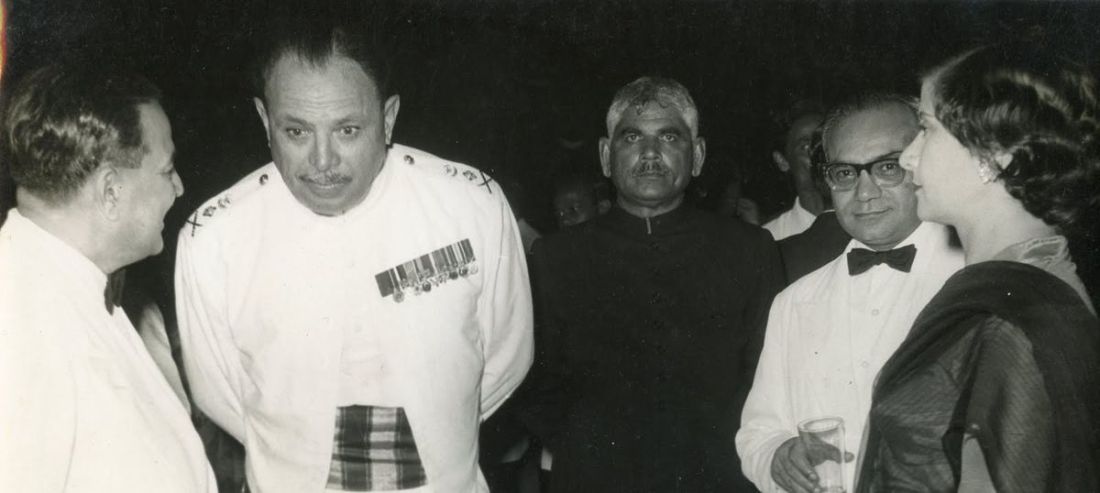
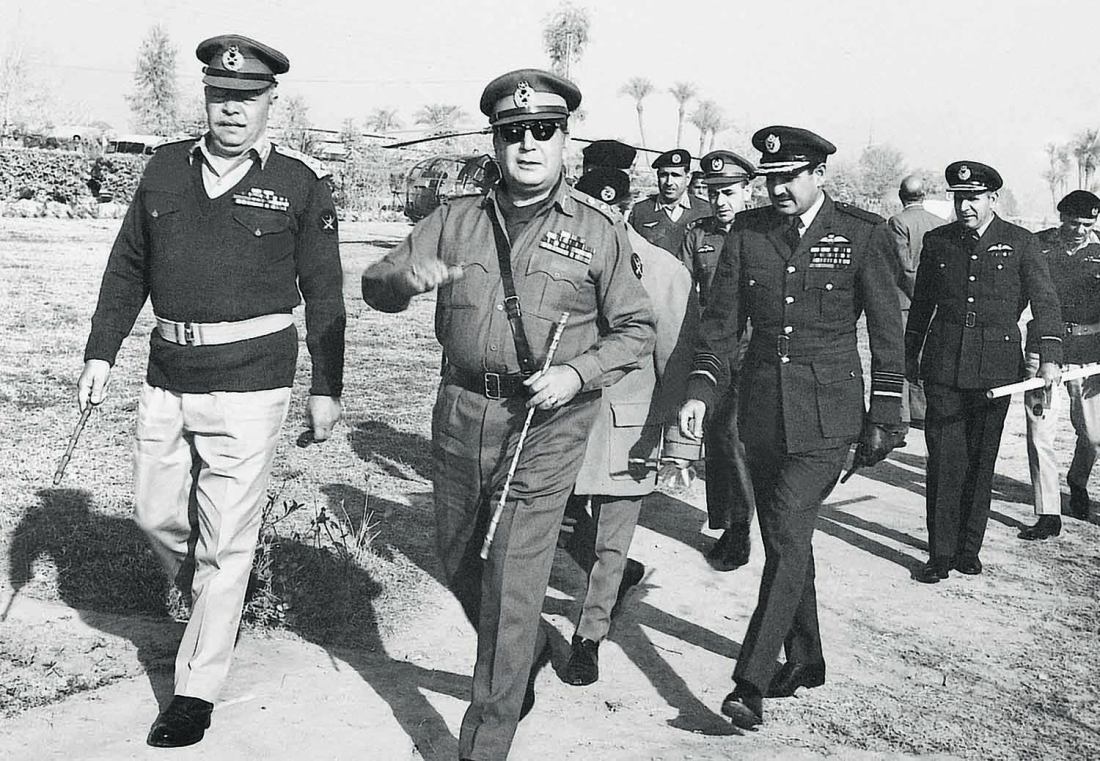
General Ayub Khan

30457-edcomnlwnz-1477996211

Pakistanis have a tendency to forget things and forgive people, especially the dead. Military dictators are among the lot who has gained the most from this habit of Pakistani nation. So is the case of General Ayub, who still has an army of repute defenders, in Khaki and suits, that continues to sing the praise of the Golden Modern age when the ‘General Saab’ once ruled the Muslim homeland. They keep reminiscing about the days when honey and milk flowed the rivers, and the economy was booming. The famous myth surrounding the Ayub’s junta is that of massive economic progress, brotherhood, and the emergence of Pakistan as Muslim world’s leader. However, the historical evidence of the time suggests otherwise.

The primary motive of General Ayub, as the historical documents suggest, was to sustain power and prolong his rule as his military generals sowed the seed for Bangladesh’s separation that came years later. The empowerment of right-wing religious fundamentalists just to secure a victory against Fatima Jinnah in the elections of 1965. The economic growth, which many cite as his singular achievement, promoted the income inequalities resulting in the rise of the 20 influential families who controlled the nation’s resources and amassed ill-gotten wealth, leaving the rest poor, hungry, and resentful. [3] From the beginning of his dictatorship, General Ayub felt annoyed by the public and democracy alike. He considered the general public to be illiterate and poor, to be trusted with the so-called adult franchise. As a result, he introduced the basic democracy system, where only a few thousand were to vote and of whom 95% elected the General as their leader. To the General, the politicians were solely responsible for the chaos inside the country and he openly called them traitors and accused them of bartering the country “for personal gains”. He swiftly jailed political leaders in East and West Pakistan. General Ayub’s nepotism of West Pakistan was one of the major causes that displeased East Pakistanis, who were the constant target of General Ayub’s ignorance, in a way that made them feel as if they were second-class citizens in a country for which they had fought. General Ayub placed three of the largest legacy projects, i.e., the construction of the new capital (Islamabad) and the two large hydel projects (Mangla & Tarbela) in West Pakistan.[4] The last nail in the coffin was General Ayub’s contempt for civil servants from the eastern wing as he never kept a confidante or a senior official in his government from East Pakistan.

The Drunken Despot

Yahya Khan

59c4b8c8ac8a4

After Field Marshal Ayub Khan resigned, General Yahya Khan became the president and martial law administrator of Pakistan (United) on 25th March 1969. It was during his presidential era that a military and economic collapse of United Pakistan, the largest Muslim country on earth, which led to disintegration and consequently the birth of what is now known as Bangladesh and Pakistan. Rumor has it that like Bahadur Shah Zafar, “General Sahib” was more interested in music, arts, and poetry. It is further said that he had a special knack for booze and Madam Noor-e-Jehan.[5] Yahya played a central role in this disintegration, as like his predecessor, he held a contempt for people of the eastern wing of the country. In July 1969, he announced the country’s first general elections. The result came and Sheikh Mujeeb-ur-Rehman, the leader of Eastern Province, won the elections, while Zulfikar Ali Bhutto, a socialist, won the majority of votes in the western province. The transfer of powers was delayed by the military ruler which further escalated the problem. General Yahya Khan visited East Pakistan for the last time on 15 March 1971. On his return, he carefully instructed his military officers in Dhaka launch the infamous Operation Searchlight against the Bengali political movement for democracy. The Pakistan army went into murderous action against the protestors and political activists of the eastern wing.
For the Top Brass of the Country, the infamous Operation Searchlight was the only way to restore the center’s writ on the renegade eastern wing. This myopic policy of controlling the masses with military might, proved to be disastrous, as protests were now metamorphosing into an unending cycle of insurgency as Bengali members of the Pakistani military and para-military forces mutinied against the center and formed the Bangladesh Forces with absolute support of the civilian Bengalis of all classes. Operation Searchlight was considered by Bengali nationalists as an equivalent of Nazi Germany’s Holocaust against the Jews in the Second World War. General Yahya subsequently arrested Sheikh Mujib ur Rahman on charges of sedition and set up a special military tribunal to deal with Mujib’s case. Mujib was awarded the death sentence,[6] but President Yahya had to put the verdict into abeyance due to the Liberation War. Yahya’s suppression of Bengalis inculcated a civil war and subsequently, India too joined the war. The birth of Bangladesh as an independent republic was the result. He subsequently apologized for his historical blunders and voluntarily stepped down.

The Charming Populist

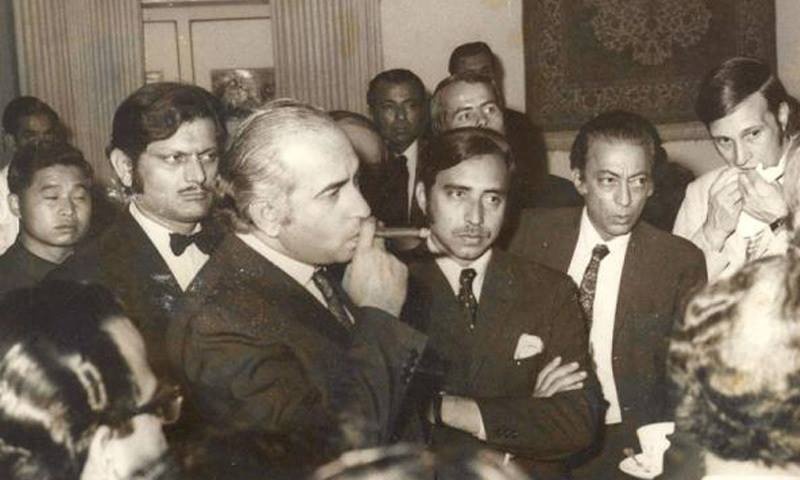
Zulfikar ali Bhutto

Old-Pakistan-Pictures-71

Zulfikar Ali Bhutto was a charismatic socialist populist leader of Pakistan and the founding father of the Pakistan Peoples’ Party. His fiery speeches and feisty body language ignite strong passions in the masses. To a large number of Pakistanis, Bhutto is Quaid e Awam or Leader of the People. But, at the same time, there are others who content that Bhutto was just a cunning charlatan who did more harm than good. The role of Bhutto in the breakup of United Pakistan is worth examining.

Bhutto, after the landslide victory of Sheikh Mujeeb ur Rehman in the 1970’s general election, made very provocative statements which played a central role in alienating Sheikh Mujeeb and his followers. The famous slogan “Udhar Tum, Idhar Hum” is also a brainchild of Zulfikar Ali Bhutto.  Zulfiqar Ali Bhutto‘s party bagged 82 of the 138 seats in four provinces of the Western wing of Pakistan but he failed to win even a single seat in the Eastern Wing. It is also rumored that he even threatened the parliamentarians of Western Pakistan and Coerced them to boycott the inaugural session of government in Dhaka, East Pakistan.

Military action coupled with the stubbornness of Zulfikar Ali Bhutto on the matter of result of general elections added fuel to the already uncontrollable fire. Bhutto had many traits of narcissism, which led him to make very provocative statements against the elected leader of the east. There is no question about his brilliance but he did have megalomaniacal tendencies too. His lust for power, delusions of grandeur and obsession with power led to disastrous results for the country.

Bhutto considered himself to be the sole spokesman of the unity between both wings of the country, but in reality, he proved himself to be one of the main architects of separation. He was, from the very start, on the side of the military establishment, in the case of military action. He completely supported the military action against members of the separation group. Even his historic paper tearing act in the United Nations was later debunked by Jamsheed Markeer, a Pakistani Diplomat, in his book “Quiet Diplomacy”, as a bluff. Bhutto signed the very document of surrender the next day after the show. Historians suggest that Bhutto had played an important role in the breakup of Bangladesh to further his own objectives.

The Lingual Ultra-Nationalist

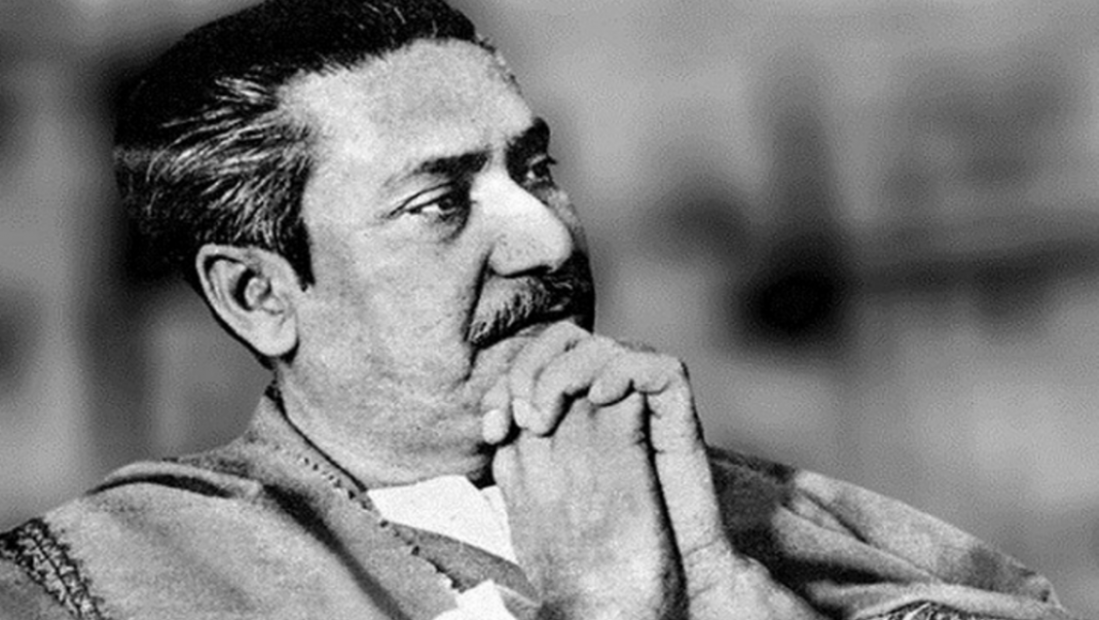
Sheikh Mujeeb-ur-Rehman

Bangabandhu-23111-1-1170x660

The Bangladeshi independence leader Sheikh Mujibur Rahman, created Bangladesh, successfully defeating Pakistani military occupation. Mujeeb received a landslide victory despite all the natural and artificial impediments in his way. These were the first free and fair elections, perhaps the only free and fair elections in the history of Pakistan. Despite the clear defeat, charming left-leaning politician Zulfikar Ali Bhutto, who had won the majority of National Assembly seats in the Western Wing, along with elements of Pakistani Civil-Military Establishment, could not digest the thought of a Bengali becoming prime minister. The traditional military and ruling elite saw India as Pakistan’s arch-enemy and considered Mujeeb-ur-Rahman as India’s Man. The Awami League felt the East would finally come out of the dark, whereas power brokers in the West saw the Awami League as an existential threat to their vested interests.

The hardest thing to digest for the Western Wing’s Establishment was the fact that Sheikh Mujibur Rahman, a Bengali had won an absolute majority of the National Assembly seats. General Yahya Khan’s announcement of the indefinite postponement of seating of the National Assembly and in effect annulment of the election results on 1st March 1971 was the final nail in the coffin. As a result, East Pakistanis took to the streets in protest against the announcement, which led to a large-scale province-wide civil disobedience movement which lasted several weeks. As a result, Yahya, Bhutto and other West Pakistani officials flew into the Eastern wing for talks of reconciliation. After several days it was reported that there was no breakthrough in the impasse between both wings.

This was followed by a bloody army crackdown on the night of March 25 of the residence of Sheikh Mujibur Rahman, he was put under arrest as a result. This was followed by heavy gunfire and arson of buildings all over Dhaka.  Reliable sources reported “atrocities, summary executions, killings on Dhaka University campus. Acquaintances dead; others terrorized. Bodies on streets, fields, stacked in parks.”[7]

The war ended after a short period and Sheikh Mujeeb was released by Pakistani authorities as a result from captivity. His other colleagues, who had been arrested during the war were released in the early months of 1972. Mujeeb, along with his supporters and headed the newly established Bangladesh government in Dhaka.

Sharing the Blame

Conclusion

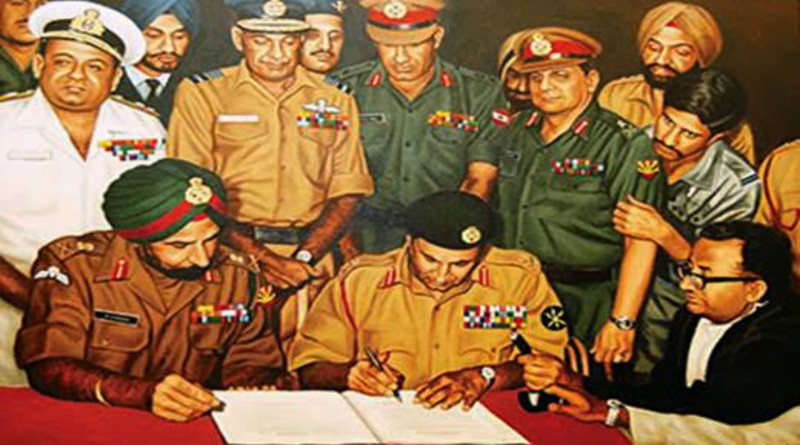
1971-surrendar-800x445

The polarization in today’s world forces everyone to take one camp or the other, but a middle ground is rarely used. People tend to opt for extreme point of views in every case, but the reality always happens to be somewhere in the middle. In Bangladesh’s war of liberation, people were either on the side of Pakistani Army or on the side of Sheikh Mujeeb’s Awami League, but somewhere in between all this, the truth was murdered brutally. US Senator Hiram Warren Johnson is purported to have said: ‘When war is declared, the truth is the first casualty’. This was more than true in the case of the War of 1971.

Pakistan’s original structure was doomed to collapse. Two separate linguistic and cultural entities, separated from each other by 1000 miles of a perceived arch-enemy’s land and based on an already faltering ideology of a pan-Islamic identity. In modern world’s context, this setup was impractical from the start. Despite all the common struggle for a Muslim Utopia, the ground realities could have never let this dream come true. Another big force in the separation of both countries was the continuous exploitation of Eastern Wing by the elites of Western Wing. The nonstop maltreatment of Bengalis at the hands of bureaucrats and military officials proved to be the final act of the tragedy. It has been 47 years since the country broke up, but the marks of war and the hatred in both countries against each other still lingers.

Primary Sources

  1. The Report of the Hamoodur Rehman Commission of Inquiry into the 1971 War – As Declassified by the Government of Pakistan
    Vanguard Publishers – ISBN: 969-402-351-3
  2. Witness to Surrender – Siddiq Salik
    Oxford University Press London
    ISBN: 0-19-577264-4
  3. The Great Tragedy – Zulfikar Ali Bhutto
    Classic Publishers Lahore

Secondary Sources


  1. forbes.com/sites/worldviews/2012/05/21/1971-rapes-bangladesh-cannot-hide-history/#35cbad2716df
  2. dawn.com/news/689976
  3. nation.com.pk/17-Dec-2016/fall-of-dhaka
  4. thenews.com.pk/jinnah-culture-language/#.WsNtuC5ubIU
  5. tanzeel.wordpress.com/2010/12/16/man-behind-the-fall-of-dhaka/
  6. https://tribune.com.pk/story/91669/1971-debacle-and-bhuttos-role/
  7. thedailystar.net/in-their-words-bhutto-and-mujib-december-1971-50468
  8. dawn.com/news/1151151
  9. countrystudies.us/bangladesh/15.htm
  10. passionpk.com/2013/03/general-ayub-khan-era-east-pakistan.html
  11. dawn.com/news/1293604
  12. nation.com.pk/16-Dec-2011/ayub-yahya-bhutto-mujib-played-part
  13. thefridaytimes.com/tft/the-fascinating-tale-of-general-rani/
  14. adst.org/2016/03/creating-bangladesh-the-triumph-and-tragedy-of-sheikh-mujib/

Citations

[1] http://www.thenews.com.pk/jinnah-culture-language/#.WsNtuC5ubIU

[2] https://nation.com.pk/17-Dec-2016/fall-of-dhaka

[3] https://www.dawn.com/news/1293604

[4] ibid

[5] http://www.thefridaytimes.com/tft/the-fascinating-tale-of-general-rani/

[6] http://www.thedailystar.net/op-ed/who-was-liar-yahya-or-bhutto-200383

[7] https://adst.org/2016/03/creating-bangladesh-the-triumph-and-tragedy-of-sheikh-mujib

[8] http://www.forbes.com/sites/worldviews/2012/05/21/1971-rapes-bangladesh-cannot-hide-history/

[9] https://en.wikipedia.org/wiki/Rape_during_the_Bangladesh_Liberation_War

​Islamabad: High on Drugs

The capital city of Islamic Republic of Pakistan is known around the world for it’s beauty, well built infrastructure and lush greenery.  It has been ranked among the most beautiful capitals of the world beside Paris and Washington D.C. There are many other aspects for which the marvellous city must be credited to.  It’s calm roads, organized traffic control system and educational excellence etc. But there is another dark side to Islamabad that is often ignored by Intellectuals when shedding light over the capital, The Drug Problem. Drug abuse by younger lot of Islamabad has become very common in the last decade. Buying drugs in Islamabad have become easier than getting a lawyer’s appointment. Drugs, specially Hashish, are very common in the social circles of students, most of whom are settled in Islamabad for higher education. There are many layers to this complex issue of addiction and drug abuse. we will be severely wronged if we treat this intricate subject in black and white terms, as considered by mainstream media.

27336920_2067030279979327_6503178128582310678_n.jpg

Image Copyright: Kashif Mahmood

Behind the curtain of addiction to drugs, there are deep psychological and emotional issues. Human beings have an innate need to bond and connect. When we are happy and healthy,  we will bond with people around us. But when we can’t , because we are traumatised, isolated or going through an Existential crisis, we will bond with something that gives us some sense of relief. Addiction to drugs is just one symptom of the crisis of disconnection. Away from home, most of these youngsters become victims of Home Sickness, a sense of alienation and constant Existential crisis.

The war on drugs that has been going on has made everything worse. We all have witnessed in the past when various state agencies have raided university campuses and arrested multitudes of students on charges of drug abuse. [1] Last February , it was reported by one of mainstream online newspapers that , under the supervision or SSP Sajid Kiani, a crackdown was initiated against drug abuse. In the same report, it was also reported that Islamabad High Court has sought a reply from the Interior Ministry and the top cops of Islamabad.  But we have all witnessed that these measures have utterly failed in stopping this menace. Most of the policies by our political establishment have been based on the classical approach to addiction. The agencies only focus on cleansing the façade of the problem while leaving the dirty backyard untouched.

We need to approach the problem of addiction with the help of Rat Park experiment conducted by Canadian Professor Bruce Alexander.  The central idea of the Rat Park experiment is that the “drugs do not cause addiction, and that the apparent addiction to opiate drugs commonly observed in laboratory rats exposed to them is attributable to their living conditions, and not to any addictive property of the drug itself.[2]” If we are to take the matter of drug abuse seriously, then we must start using our energies on educating the addicts and helping them recover from this disease. Instead of turning addicts into social outcasts, we should help people heal and get their lives together.

Addiction is a serious disease, and the addicts deserve a more humane and compassionate behavior.

————————————————————––————

References

1: https://tribune.com.pk/story/1321093/high-er-studies-police-bust-three-university-student-dealers/

2:https://en.m.wikipedia.org/wiki/Rat_Park

Project Pakistan History

In the modern world, re-writing history is considered one of the most important tools of nation building. Almost every state, especially the ones belonging to third world bend or distort historical facts to tailor a national narrative that may fit the state’s version of the ideology. It may be useful but there are always limits to everything. In the case of Pakistan, which is to say a country that has a mixture of various ethnicities and language speaking groups, the state imposes Islam to be the common denominator as the majority of the population of Pakistan is Muslim.

After winning independence from the British, the leadership of the new country faced many challenges as the practicality of two nation theory was collapsing due to the violence based on language. In that sad moment, Bureaucrats and politicians of the nascent country used Islam as a combining force as a desperate move to shape the nation but this step proved to be a myopic one in the coming days of the state.

The newly tailored Pakistan ideology based on two Nation Theory, even though propagated on the peak of drum failed to impress any large chunk of the population. From the very start, Sindhi politicians and leaders blamed their Punjabi counterparts for not giving them an equal share in power, the Pashtuns also blamed the Punjabis for using the holy name of Islam for their unholy objectives of hijacking the state machinery. At the same time, a civil war broke out in the province of Baluchistan between the already infamous Pakistan military and the Baloch separatists who still claim Baluchistan to be an independent state. The last nail in the coffin of this new Islamic Ideology of Pakistan was the Civil war in East Pakistan (Bangladesh after the fall of Dhaka in 1971), as Bengalis also alleged that Punjabi military-civil officers had left them out of power in the center, even though they were the biggest majority of Pakistan.

Due to the complexities that were either inherited or created by the myopic policies of Pakistani State, the Establishment took another childish step and started purging anything or anyone that went against its version of the history and ideology. This Pakistan Ideology project included censoring newspapers, banning books, re-writing history books and creating a stricter version of Pakistan ideology and a fictitious (based on cherry-picked speeches and facts) version of events that led and followed the independence. After creating this new faltering version of the historical narrative, anyone who tried to question its practicality was dubbed either a traitor or an Indian agent. To make matters worse, Pakistan’s Military who has staged four successful coups in the short lifespan of the young nation added their share of ideological fiction and stories about bravery during wars against India into the state’s version of the history.

american-public-school-brainwashing-campaign

While analyzing the alterations made to the history by state-actors and its impact on the mindset of the generations that followed every thinking person becomes worried and disappointed. As all the books on Pakistan’s History printed either by state Publishers or government Text Book Boards have more fiction than facts.

They completely censor the rich cultural heritage and background of all the ethnic groups. The oppression against history and culture, sponsored and enforced by state departments under the banner of Islam, unity and Islamic ideology is simply preposterous. It has created a generation of conformists and narrow-minded religious bigots who sometimes backfire and cause real damage to the state itself.
People despise their culture so much – the state has indoctrinated them into thinking that it will create divisions among the nation – that they are even ashamed of speaking their mother tongue in front of their parents even. (Common among newer generations of Urban Punjabis).
The history has been rewritten so many times that it has become a farce. Instead of building a national narrative with consensus from all the groups dwelling in Pakistan, the Pakistani establishment has created one that has done more harm than good. The state should try to learn from its mistake and try to create a national ideology that goes hand in hand with cultural diversity and pluralism. It should spread the message of “Unity in Diversity” or else the state building project will falter and Pakistan might become a black comedy in the future history of the world.